Jazz Chord Progression Ear Trainer
A piano-and-bass duo swings through a two- or four-bar progression in a random key. Your job: name every chord, bar by bar. Real rootless voicings, walking roots, and the changes you'll actually meet on a gig. Free in your browser, no signup.
Hear the changes now, freeNo account needed. Works on phone and desktop.
How it works
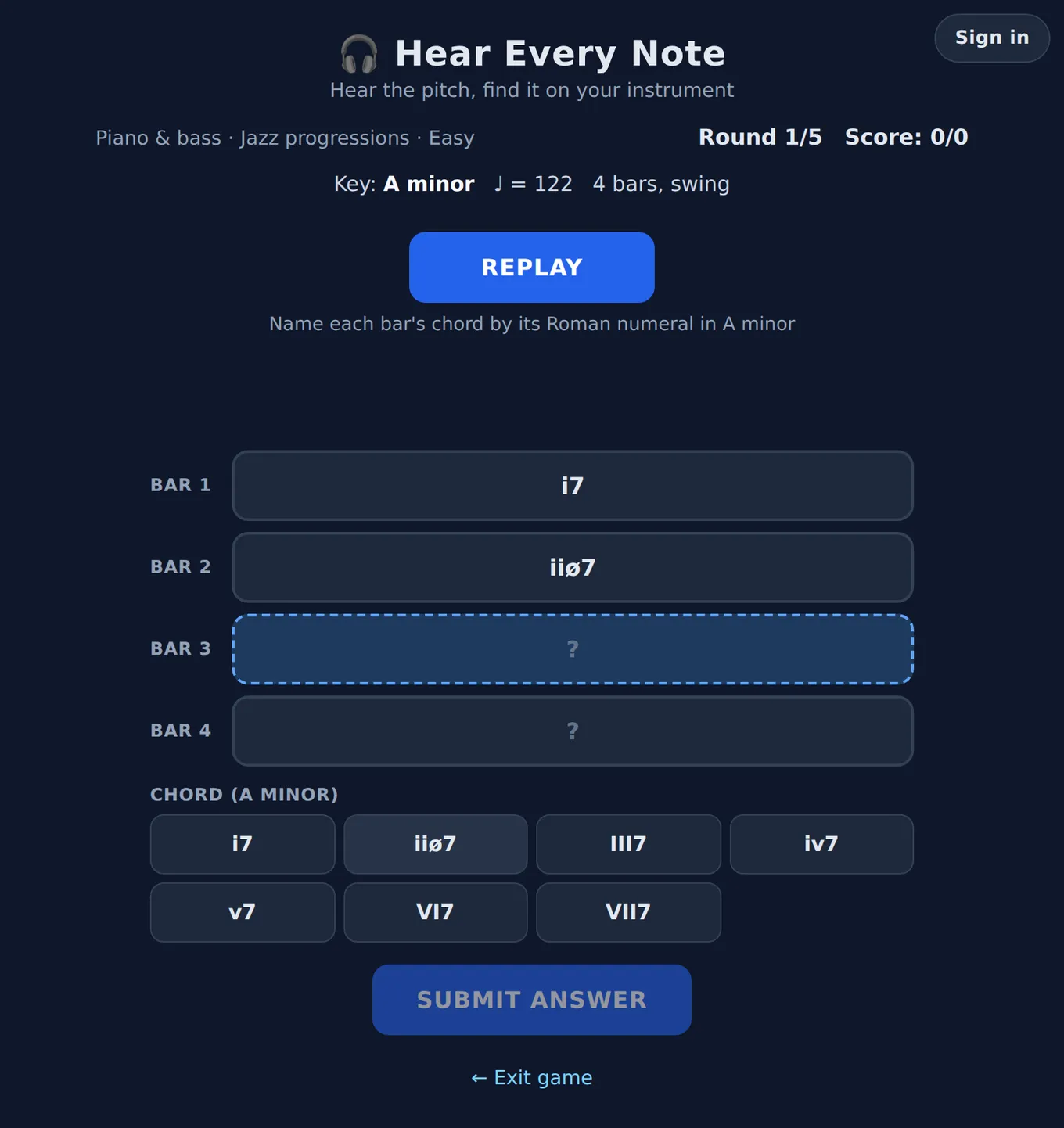
- Pick Piano, then Jazz progressions, then a difficulty. The game shows you the key, the tempo, and how many bars are coming.
- Press PLAY. A piano plays the chords in rootless jazz voicings while a bass walks the roots underneath, at a medium swing tempo.
- Name each chord in order. On Easy you tap a Roman numeral (ii7, V7, I7…). On Medium and Hard you pick a root and a quality to build the exact chord symbol, just like reading a lead sheet.
- Replay as often as you like, then submit. Every chord is marked right or wrong, and a round only scores when you got all of them. Five rounds per game, and a perfect game is 5/5.
Hear the changes, not just the chords
Most chord ear trainers play one chord in isolation and ask for its quality. That's a useful drill, and our chord trainer goes further by making you find every note. But jazz doesn't happen one chord at a time. A ii7 only sounds like a ii7 because of the V7 that follows it and the I that follows that. This mode trains the skill that matters on the bandstand: hearing where a progression is going, recognizing a turnaround before it resolves, and catching a tritone sub the moment the bass moves a half step instead of a fifth.
The key is always shown, so you're never guessing a root out of thin air. You're hearing each chord's function against a tonic you already know, which is exactly how relative pitch works for the musicians who transcribe solos and pick up tunes by ear.
Three difficulties, one growing vocabulary
- Easy: Roman numerals. One chord per bar, keys with up to two sharps or flats, and only the diatonic seventh chords: maj7, m7, 7, and m7♭5, so viiø7 in major and iiø7 in minor are real answers rather than distractors. Progressions include the I-vi-ii-V turnaround, ii-V-I, iii-vi-ii-V, I-V-vi-IV, and minor-key iiø-v-i. 104 to 126 BPM.
- Medium: chord symbols. Up to two chords per bar, all twelve keys, and the vocabulary adds augmented chords and dominant 9ths. Expect ii-V-I in two bars, the eight-chord I-vi-ii-V-iii-VI-ii-V, and I-I+-IV-V. 112 to 144 BPM.
- Hard: the real book. Adds sus2, sus4, 7sus4, 11ths, and 13ths. Progressions include tritone substitutions (I-♭III7-ii-♭II7), the backdoor iv-♭VII7-I, modal sus vamps, and minor-key lines that borrow ♭VI and ♭III. 120 to 160 BPM.
Built to sound like a rhythm section
The piano plays rootless shell voicings on Easy and four-note rootless voicings on Medium and Hard, chosen by voice leading so the top line moves the way a comping pianist's would. The bass plays roots on the downbeats and deliberately never lands on a chord's 3rd or 7th on beat one, so it reinforces the root without giving away the quality. The whole arrangement is seeded from the round, which means REPLAY is note-for-note identical, so you can listen for one voice at a time. No drums, and no synthesized "chord stab": the sounds are sampled acoustic piano and finger bass.
Tips for hearing jazz progressions
- Follow the bass first. Roots moving in fifths (ii to V to I) are the backbone of jazz harmony. Once you can track the bass, the quality of each chord is a smaller question.
- Find the resolution and work backwards. The last chord is usually I or a chord that sets up the next chorus. Name it, then ask what led there.
- Sing the guide tones. The 3rd and 7th of each chord define its quality, and in a ii-V-I they step down by half steps. Hum that line and the qualities reveal themselves.
- Learn the pairs that fool you. maj7 versus 7 is one note (the 7th). m7 versus m7♭5 is one note (the 5th). Replay and listen for that single pitch.
- Stay on Easy until Roman numerals feel automatic. Medium asks the same question in twelve keys with real chord symbols, and that jump is much smaller when the functions are already in your ear.
Who this is for
Anyone learning jazz harmony by ear: pianists and guitarists comping from lead sheets, horn players who want to hear the changes under a solo instead of counting bars, singers learning to place a melody over a turnaround, and theory students who can spell a ii-V-I on paper but can't yet pick it out of a recording. If you're brand new to ear training, start with how to recognize chords by ear and a few rounds of intervals first. Chord qualities are just intervals heard from the bass up.
Frequently asked questions
Which progressions does the trainer play?
Hand-written functional progressions transposed into a random key: ii-V-I, the I-vi-ii-V turnaround, iii-vi-ii-V, descending-fifths chains, minor-key iiø-V-i, and on Hard, tritone substitutions, the backdoor iv-♭VII7-I, and modal sus progressions. Nothing is a random chord sequence.
Do I need perfect pitch?
No. The key is always shown before you answer, so the task is relative-pitch chord recognition: hearing each chord's function and quality against a tonic you already know. That is the skill working jazz musicians use on the bandstand.
How are answers graded?
Every chord in the progression is marked separately, and a round only scores when all of them are right. Roots are graded by pitch class, so D♭ and C♯ both count. C11 and C7sus4 are treated as the same sound, because they are voiced identically.
Why is jazz progression mode only on piano?
You always hear the progression as a piano-and-bass duo, whatever instrument you play, so the mode lives under Piano. Horn players are welcome: the chord symbols you answer with are concert pitch, exactly as they appear on a lead sheet.
Is it free?
Yes. Every mode, instrument, and difficulty is free, and you don't need an account to play.
Want the single-chord version first? Try the chord ear trainer, or keep the habit going with the daily challenge.