Chord Ear Trainer
A triad or seventh chord plays, in any inversion. Your job: pick out every note it contains. Real piano, guitar, and string sounds, free in your browser, no signup.
Start training now, freeNo account needed. Works on phone and desktop.
How it works
- Pick a polyphonic instrument (piano, guitar, bass guitar, violin, viola, cello, or double bass) and a difficulty.
- Each round plays a triad or seventh chord, voiced in any inversion, anywhere in your chosen range.
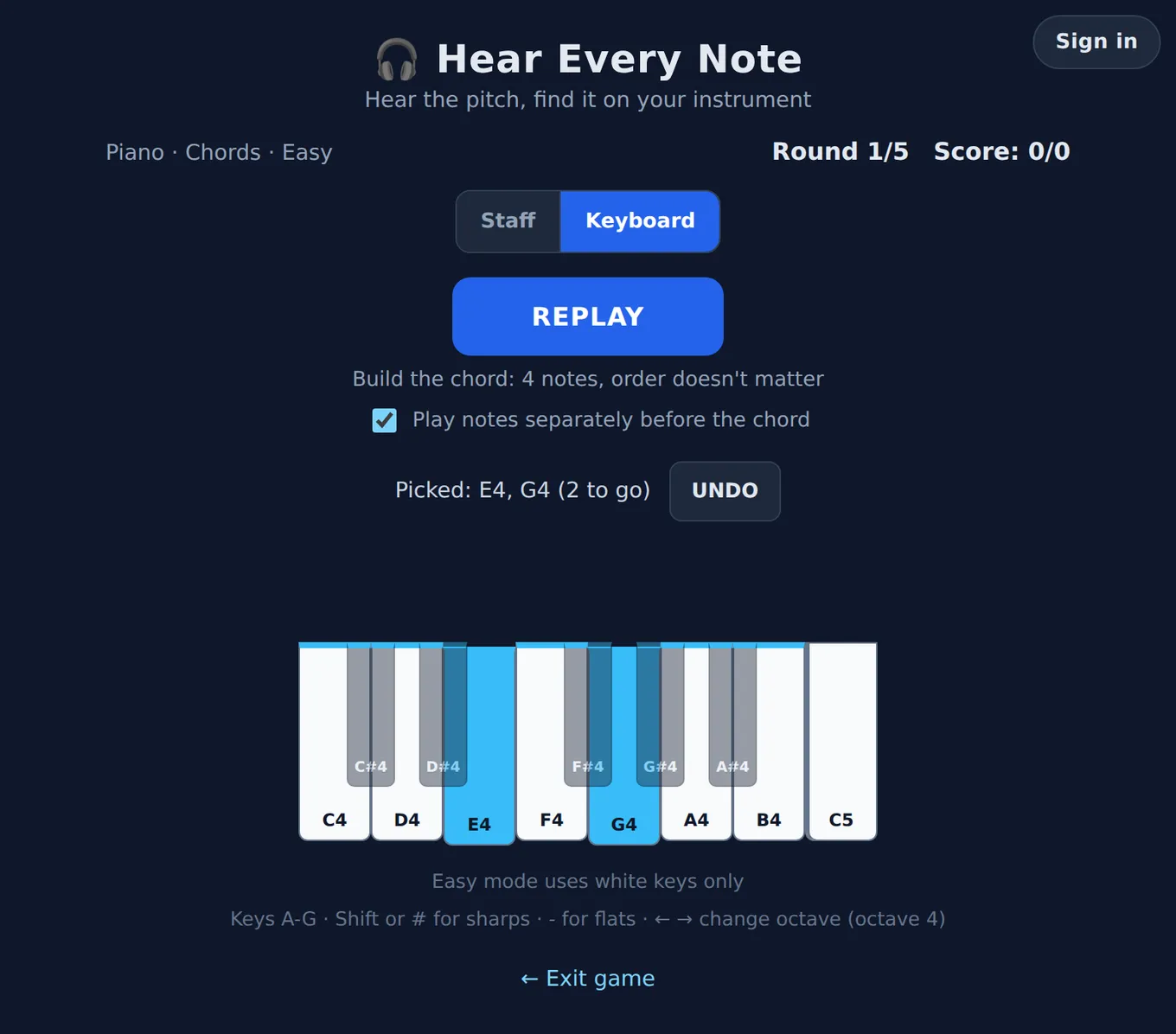
- Enter every note you hear on a staff or piano keyboard. Order doesn't matter; hearing them all does. And you can replay the chord as often as you like.
- Five rounds per game, and a round only counts once you've found all the notes. A perfect game is 5/5.
Hear inside the chord
You can know a chord is a minor seventh and still have no idea which note sits on top. It happens to everyone. This trainer makes you find every individual pitch, the way a transcriber or arranger has to hear through a block of sound to the voices inside it. Stick with it and inversions stop being trick questions. They become voicings you've heard before.
Learn with training wheels, then take them off
Chords are hard when all the notes land at once. So there's a toggle that plays them one at a time, like an arpeggio, while you're getting started, then all together when you're ready for the real challenge. On wind and brass instruments, which can't sound a chord at all, the same questions live in a dedicated Arpeggios mode where the notes always come one at a time. Difficulty scales too: Easy keeps chords inside an 8-note major scale, Medium opens up a chromatic octave, Hard uses the full instrument range, and Custom lets you set your own limits.
Tips for chord ear training
- Find the bass note first. It anchors the chord, and the upper voices are just intervals above it, the same ones you already know from interval training.
- Sing the chord bottom-to-top before answering. Arpeggiating with your voice forces you to resolve each pitch.
- Treat the play-separately toggle as a step, not a home. Switch it off as soon as you're doing better than chance.
- Short daily games beat long weekly ones. The app keeps a daily streak to make showing up easy.
A practical order for learning chords by ear
Don't try to hear everything at once. Start with major and minor triads in root position, and learn to tell that pair apart until it's boring. Then add inversions of the same two qualities: same notes, different bass, surprisingly different color. Diminished triads come next (that stack of minor 3rds has a tension you won't mistake for anything else), and seventh chords come last. Dominant, major, and minor sevenths cover most of the music you'll ever transcribe. And because you find every note here instead of clicking a quality label, each stage builds directly on your interval skills. Think about it this way: a chord is intervals stacked, heard from the bass up.
Brand new to ear training? Start with the beginner's guide, which walks through notes, then intervals, then chords. Once the basics click, let the daily challenge rotate you through all three modes.
Frequently asked questions
What chords does the trainer play?
Triads and seventh chords, in any inversion, built anywhere in the range you've chosen. And you don't just name them: you identify every note in the chord, from the bass up.
Why isn't chord mode available on my instrument?
Chord mode needs an instrument that can sound several notes at once, so you'll find it on piano, guitar, bass guitar, violin, viola, cello, and double bass. Winds and brass get Arpeggios mode instead: the same triads and seventh chords played one note at a time, alongside single-note and interval training.
Can I hear the chord notes one at a time?
Yes. On piano and strings, a toggle lets you hear the notes played separately as an arpeggio while you're learning, then together once you're ready for the harder version. On wind and brass instruments, the dedicated Arpeggios mode always plays the chord one note at a time.
Is it free?
Yes. Every mode, instrument, and difficulty is free, and you don't need an account to play.
Want the listening method first? Read how to recognize chords by ear, or brush up on intervals. Chords are built from them, after all.