Interval Ear Trainer
Two notes play. You find both pitches by ear, on a music staff or piano keys, in the real sound of your own instrument. It's free, it runs in your browser, and there's no signup.
Open the interval trainerOpens on piano with the first two notes ready: press PLAY to hear them. Play something else? Pick your instrument first. No account, phone or desktop.
How it works
- Pick your instrument (piano, guitar, strings, winds, or brass) and a difficulty.
- Each round plays two notes, ascending or descending. It's a true 50/50, so you can't cheat by guessing the direction.
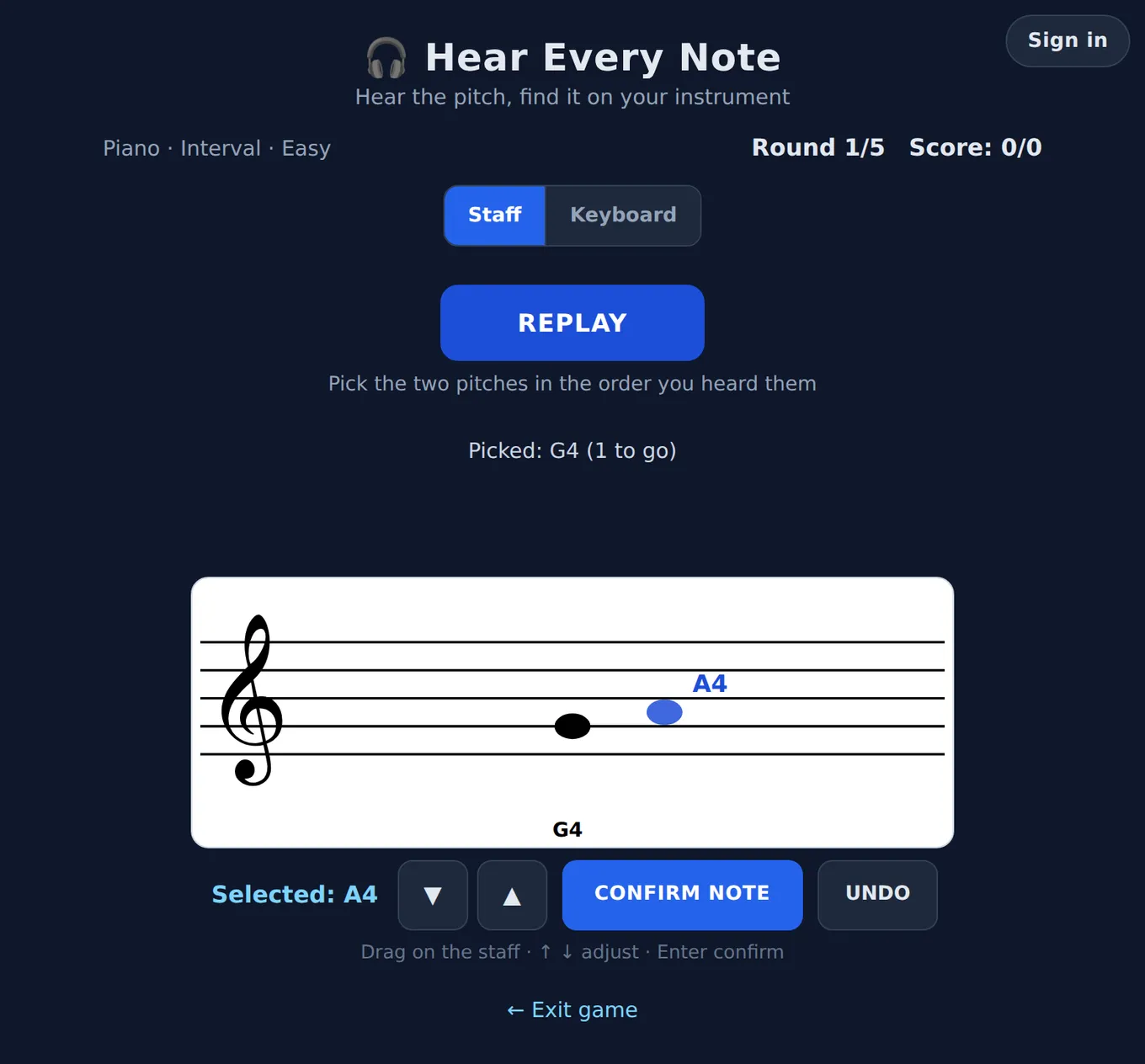
- Enter both notes in the order they played, on a staff or a piano keyboard. Replay them as many times as you need. Nobody's counting.
- A game is five rounds, and a round only counts when you get both notes right. A perfect game is 5/5.
Two ways to train
Not sure which to pick? Go with the level that matches where you are right now. In Interval names mode you hear two notes and pick the label ("major third", "perfect 5th"). That's the classic way to build interval vocabulary. Interval mode goes further: you locate both actual pitches, which is exactly what you do when you transcribe a melody or play by ear. If intervals are new to you, start with names. Once you can hear the notes themselves, naming them is the easy part.
Difficulty that grows with you
- Easy keeps every note inside an 8-note major scale.
- Medium opens up a full 13-note chromatic octave.
- Hard uses your instrument's entire range.
- And Custom lets you set your own range, say, just the octave you're working on this week.
Tips for learning intervals faster
- Start on Easy. The major scale limits the choices, so your ear gets to learn scale degrees before it has to wrestle with chromatic notes.
- Sing what you hear before you answer. If you can hum both notes, you've already done the hard part.
- Tie each interval to a melody you know, in both directions. The first two notes of a tune you can recall instantly make a reliable anchor.
- Practice a little every day instead of a lot once a week. Five-round games are short on purpose, and the app tracks your daily streak.
Anchor songs: your first handles on each interval
While your ear is still learning, borrow melodies you already know. Hum the first two notes of the Jaws theme: that's a minor 2nd. "Happy Birthday" has one on "-py Birth-", "Here Comes the Bride" with a perfect 4th, Star Wars with a perfect 5th, and "My Bonnie Lies Over the Ocean" with a major 6th. Hear an unknown interval, check it against your mental jukebox, answer. There's a full list of all twelve intervals, ascending and descending, on the songs for intervals page. You won't need the anchors forever. After a few weeks of play, a perfect 5th just sounds like a perfect 5th. No Star Wars required.
Train on the instrument you play
If you play violin, your ear is tuned to violin overtones, not to sine-wave beeps. Interval recognition transfers fastest from a familiar timbre, so every exercise here sounds like a real instrument. Transposing players (clarinet, trumpet, saxophone, horn) answer in written pitch while the audio sounds at concert pitch, exactly the translation you already do on the bandstand. And when intervals start feeling easy, the daily challenge rotates you through intervals, chords, and single notes: one shared five-round puzzle per day, same questions for everyone.
Ear training for every instrument
Every instrument has its own guide: which intervals its repertoire leans on, how its clef and transposition show up in the trainer, and a 10-minute routine that opens the game with that instrument's real sound.
Frequently asked questions
Should I start with Interval mode or Interval names?
Start with Interval names if intervals are new to you: two notes play and you pick the label, which builds the vocabulary. Switch to Interval mode once a few intervals sound familiar. It asks for both actual pitches on the staff or keys, the skill you use to transcribe a melody or play by ear.
Which intervals should I learn first?
Start on Easy, where every note sits inside one major scale, and let the trainer mix the intervals. Most people lock in the perfect 5th and the octave first, then the major and minor 3rd. The major 2nd and the tritone usually take longest. Anchor songs help: a melody you know for each interval, in both directions.
Why do descending intervals feel harder?
Most familiar anchor songs go up, so a falling interval has no handle yet. The trainer plays ascending and descending at random, a true 50/50, so you can't lean on direction. Learn one descending anchor per interval and the gap closes within a couple of weeks.
Are the intervals melodic or harmonic?
Melodic: the two notes play one after the other, ascending or descending, and you enter them in the order you heard them. Notes sounding together are the job of the chord trainer, where you pick out every note of a triad or seventh chord.
Opens on piano, Easy, first pair ready. Or pick your instrument first. Prefer to name them? Open it in Interval names instead. Free, no account.
Brand new to intervals? Start with what is an interval? and the anchor songs list, or follow the 10-minute daily routine.