Ear Training Exercises
Five ear training exercises, each one a short game you can start in one click: find one note, find two notes in the order they played, name the interval, find every note of a chord, and name the chords of a jazz progression. Real instrument sounds, free, no account. Here is what each exercise trains and how to run them in ten minutes a day.
Start exercise 1: find one noteOpens the game on piano, note recognition on Easy. Press PLAY and the first note sounds. Free, no account. Rather use your own instrument? Pick it on the home page.
The five exercises
- Find one note. Hear a single pitch and find it on the staff or the keys. Trains pitch memory.
- Find two notes in order. Hear two notes and place both in the order they played. Trains intervals as pitches.
- Name the interval. Hear two notes and pick the interval name. Trains intervals as labels.
- Find every note of a chord. Hear a triad or seventh chord and pick out each note. Trains chord quality and inversions.
- Name the changes. Hear a piano-and-bass duo play a progression and name each chord. Trains harmonic hearing in a key.
Every exercise is scored the same way: five rounds, all or nothing per round, unlimited unscored replays of the current prompt. Three of the five ask you to write down what you hear, placing the actual notes, which is the skill you use to transcribe a melody, play by ear, or sing in tune. Naming the interval and naming the changes ask for names on purpose, so the vocabulary gets fast too.
Exercise 1: find one note
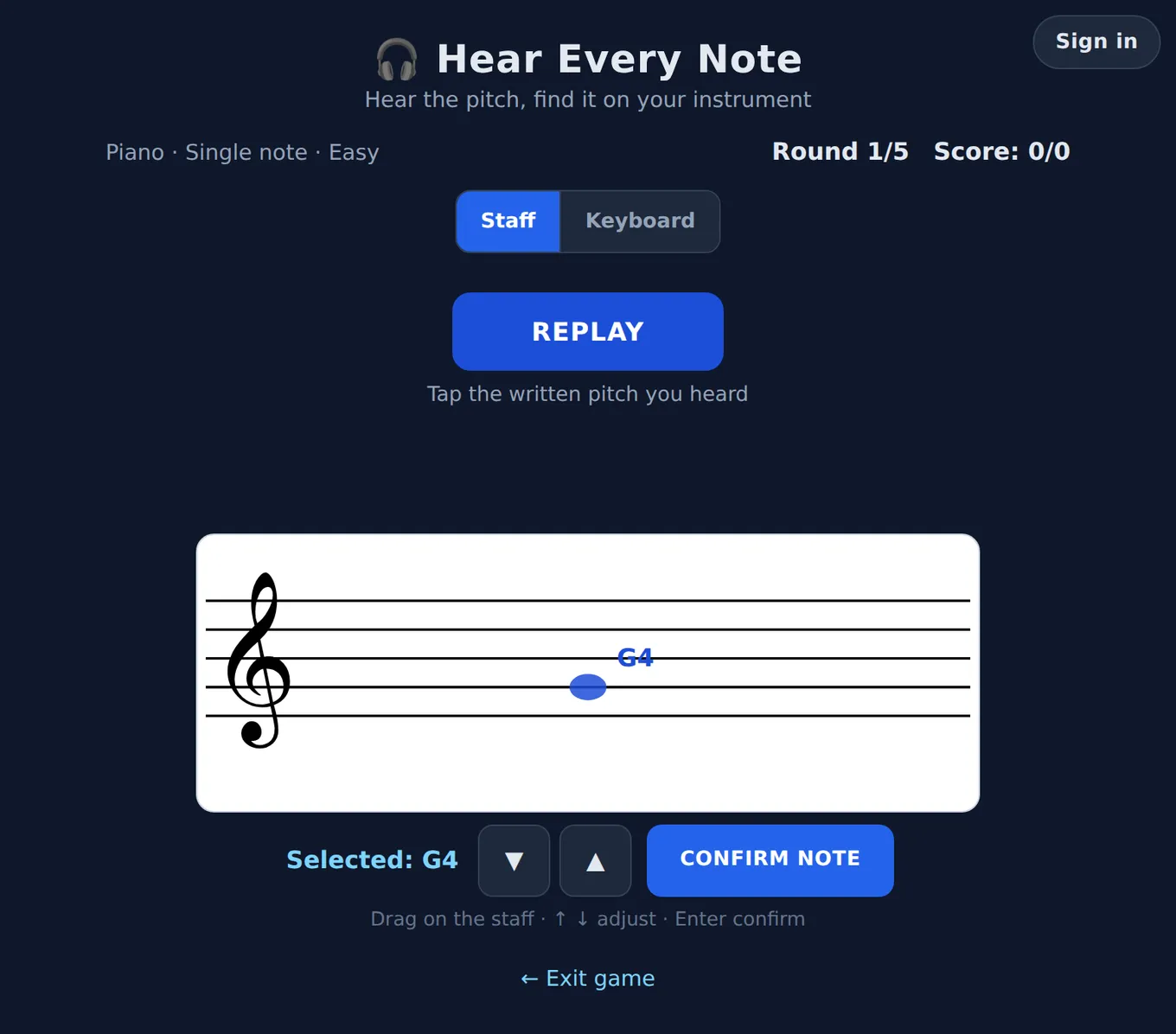
One pitch plays. You hold it in your head and find it on a staff or a piano keyboard. On Easy the note comes from the eight notes of a C major scale, on Medium from all 13 notes of the chromatic octave (C to C), and on Hard from your instrument's whole range. This is pitch memory, the skill that lets you keep a reference note in your ear for the rest of a tune, and it is the exercise every other one stands on. Start here for your first week.
Start this exercise (piano, Easy) · About note recognition
Exercise 2: find two notes in order
Two notes play, one after the other. You place both on the staff or the keys, in the order they sounded. This is interval training the way a transcriber does it: not "that was a 5th" but "that was G up to D". Give descending pairs equal time, because melodies fall as often as they rise. If a distance has no name in your ear yet, songs for intervals gives you a tune to hang it on.
Start this exercise (piano, Easy) · About the interval trainer
Exercise 3: name the interval
The same two notes, but now you answer with the interval's name, minor 2nd through octave. Faster than exercise 2, and the easy way in: on Easy it asks only five intervals, so you learn the most distinct sounds by name first. Move on to exercise 2 as soon as a few feel familiar, and keep both in your week: a name without the pitches behind it does not help you find the note on your instrument. What is an interval explains the names.
Start this exercise (piano, Easy) · About interval names mode
Exercise 4: find every note of a chord
A triad or a seventh chord plays, in any inversion, and you pick out every note in it. This trains chord quality (major, minor, diminished, augmented, the seventh types) and inversions at the same time, because you cannot find the notes without hearing which one is on the bottom. On piano, guitar and the other string instruments the chord sounds all at once, with an option to play the notes separately before the chord. On a single-line instrument the same voicings come note by note as Arpeggios mode. The listening order is in how to recognize chords by ear.
Start this exercise (piano, Easy) · About the chord trainer
Exercise 5: name the changes
A piano-and-bass duo plays a short jazz progression, a ii-V-I, a turnaround, a tritone substitution, in a random key, and you name every chord. The key is always shown, so this is relative hearing: where does each chord sit in the key, and what quality is it. Easy answers in Roman numerals, Medium and Hard in exact chord symbols. Piano only. It is the exercise for anyone learning tunes from records or comping through a real book.
Start this exercise (piano, Easy) · About the jazz progression trainer
How to run the exercises in ten minutes a day
Take them in order. A week of exercise 1 before exercise 2, a few weeks of 2 and 3 before 4, and 5 whenever harmony is the thing you are working on. A good daily session is two or three exercises, hardest one first while you are fresh, and the daily challenge at the end for the streak. The 10-minute daily routine lays this out week by week, and how to train your ear explains why the order matters. If you play a particular instrument, its own guide builds the same routine around your register and repertoire; every instrument is listed on the guides page.
Frequently asked questions
What is the best ear training exercise for a beginner?
Find one note. It builds pitch memory, which every other exercise stands on, and on Easy it uses only the eight notes of a C major scale. A week of it, ten minutes a day, is enough to start intervals.
How long should an ear training exercise take?
Each game is five rounds, about two minutes. A good daily session is ten minutes: two or three exercises, the hardest one while you are fresh. Short daily sessions beat a long weekly one.
Are these ear training exercises free?
Yes, every exercise, every instrument, and every difficulty level. No account, no download, no paywall. A small amount of advertising keeps the site free.
Can I do the exercises with my own instrument's sound?
Yes. The links here start each exercise on piano; the home page lets you pick any of 21 instruments. Transposing instruments hear concert pitch and answer in written pitch, so you practice in the notation you read.
Start exercise 1: find one note
Note recognition on Easy, on piano; press PLAY to hear the first note. Free, no account.