Songs to Remember Intervals
Here's the fastest way to learn intervals by ear: tie each one to the opening of a song you already know cold. Two notes into Jaws and you've heard a minor 2nd. Two notes into Star Wars, a perfect 5th. Below is the full anchor-song list, ascending and descending, plus how to actually practice with it.
Test yourself on intervalsThe interval trainer is free, no account needed.
How anchor songs work
An interval is the distance between two pitches, and every interval has its own recognizable flavor: the minor 2nd's menace, the perfect 4th's fanfare, the major 6th's warmth. An anchor song borrows a melody your brain memorized years ago and uses its first two notes as a reference. So when an unknown interval comes along, you check it against your mental jukebox: "that leap feels like My Bonnie, so major 6th."
Two rules make anchors stick. First, the song has to be one you can start singing instantly. A song you half-know is worse than no song at all, so swap in your own favorites freely. Second, learn each direction separately. An ascending major 3rd and a descending major 3rd feel like completely different animals, and you want an anchor for each.
Ascending intervals
| Interval | Semitones | Anchor songs (first two notes) |
|---|---|---|
| Minor 2nd | 1 | Jaws theme; Pink Panther theme |
| Major 2nd | 2 | "Happy Birthday" ("Hap-py"); "Frère Jacques" |
| Minor 3rd | 3 | "Greensleeves" ("A-las"); Brahms' "Lullaby" |
| Major 3rd | 4 | "When the Saints Go Marching In" ("Oh, when"); "Kumbaya" |
| Perfect 4th | 5 | "Here Comes the Bride"; "Amazing Grace" ("A-ma") |
| Tritone | 6 | The Simpsons ("The Simp-"); "Maria" (West Side Story) |
| Perfect 5th | 7 | "Twinkle, Twinkle" ("Twin-kle twin-"); Star Wars main theme |
| Minor 6th | 8 | "Manhã de Carnaval" (Black Orpheus); The Entertainer (third and fourth notes) |
| Major 6th | 9 | "My Bonnie Lies Over the Ocean" ("My Bon-"); the NBC chimes |
| Minor 7th | 10 | "Somewhere" (West Side Story, "There's a…"); Star Trek original theme |
| Major 7th | 11 | "Take On Me" (a-ha, chorus leap); "Don't Know Why" (Norah Jones, opening) |
| Octave | 12 | "Somewhere Over the Rainbow" ("Some-where") |
Descending intervals
| Interval | Semitones | Anchor songs (first two notes) |
|---|---|---|
| Minor 2nd | 1 | "Für Elise" (opening); "Joy to the World" ("Joy to") |
| Major 2nd | 2 | "Mary Had a Little Lamb" ("Ma-ry"); "Yesterday" ("Yes-ter") |
| Minor 3rd | 3 | "Hey Jude" ("Hey Jude"); "Frosty the Snowman" ("Fros-ty") |
| Major 3rd | 4 | Beethoven's 5th (the famous four notes); "Swing Low, Sweet Chariot" ("Swing low") |
| Perfect 4th | 5 | "Born Free"; "I've Been Working on the Railroad" ("I've been") |
| Tritone | 6 | European two-tone siren; "Blue Seven" (Sonny Rollins) |
| Perfect 5th | 7 | The Flintstones ("Flint-stones"); "Feelings" |
| Minor 6th | 8 | "Love Story" theme ("Where do I begin") |
| Major 6th | 9 | "Nobody Knows the Trouble I've Seen" ("No-bo-dy"); "Man on the Flying Trapeze" |
| Minor 7th | 10 | "Watermelon Man" (Herbie Hancock, opening horn line) |
| Major 7th | 11 | Famous anchors are rare; most players learn it as "an octave, minus a half step" |
| Octave | 12 | "Willow Weep for Me"; "The Lonely Goatherd" yodel (Sound of Music) |
How to practice with anchor songs
- Pick four intervals, not twenty-four. Start with ascending m2, M2, P4, and P5, the most distinctive of the bunch. Add pairs (m3/M3, m6/M6…) once those four are automatic.
- Sing the anchor, then just the interval. Sing "Here Comes the Bride," then only its first two notes, then just those two notes in your head. You're compressing a whole song down to one interval.
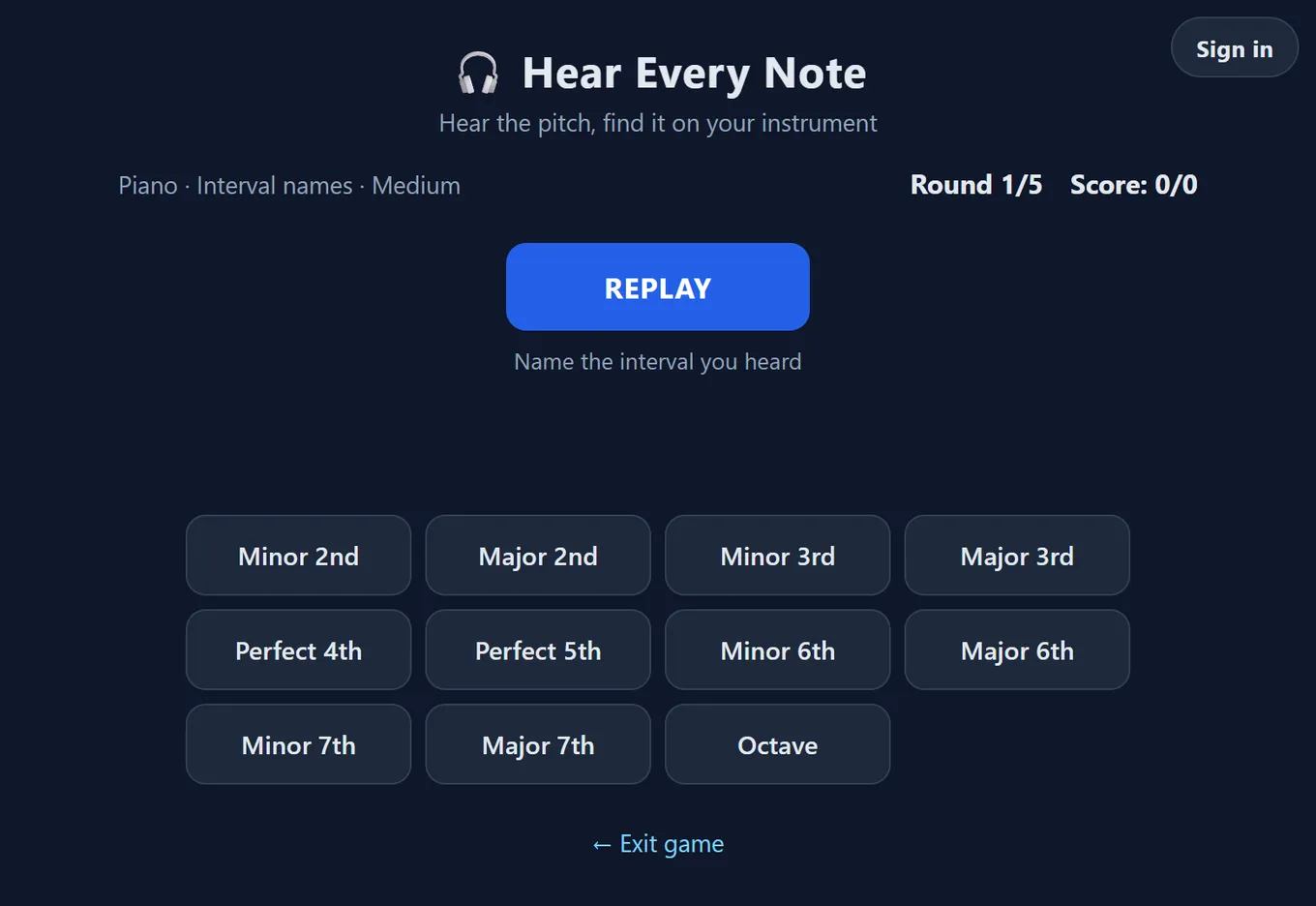
- Quiz yourself with real audio. Recognition only counts when the notes come from outside your own head, and a trainer that plays random intervals and scores you keeps the practice honest. That's exactly what our free interval ear trainer does. Start by naming the interval, then level up to identifying the actual pitches.
- Wean yourself off the anchors. They're scaffolding, nothing more. After a few weeks, the m6 won't need "the Love Story leap" anymore, and that's the whole goal.
The catch with anchor songs
Here's the thing about anchors: they identify intervals one at a time, from the bottom note, at singing speed. Real music moves faster than that, leaps in both directions, and doesn't wait around while you hum My Bonnie. So treat anchor songs as your first foothold, then push toward hearing intervals directly: in context, in any register, on the instrument you play. Our beginner's guide to ear training lays out that whole progression, and the daily challenge keeps you honest five rounds at a time.
Related reading: what is an interval? · ear training for singers · transcribing by ear