Perfect Pitch vs Relative Pitch
Perfect pitch names a note out of silence. Someone plays an F♯ and you just say "F♯," no reference needed. Relative pitch names it from context: give you any known note, and you can find every other one by its distance. One is a rare quirk of early childhood. The other is the trainable skill almost every working musician actually runs on.
Test your pitch memory, freeNo account needed. Works on your phone or your laptop.
What perfect pitch is
Perfect pitch (researchers call it absolute pitch) is the ability to identify or produce a specific pitch with no external reference at all. It's genuinely rare, commonly estimated at roughly 1 in 10,000 people, and it shows up more often among musicians who started very young and among speakers of tonal languages. For the people who have it, it works like color vision: an A♭ simply is A♭, the way a stop sign is red.
But it has an unglamorous side too. Absolute-pitch musicians often struggle when an orchestra tunes to a different reference, when a piece gets transposed, or when age shifts their internal reference. The label sticks to the frequency, not to the music. Perfect pitch is neither necessary nor sufficient for musicianship, and plenty of celebrated musicians never had it.
What relative pitch is
Relative pitch is hearing relationships: this note is a perfect 5th above that one, this chord is the IV of the key, this melody starts on the 3rd of the scale. Hand a strong relative-pitch musician a single reference note and they can name everything that follows: transcribe the solo, hear the changes, sing their part in tune. It's the skill behind playing by ear, improvising, and arranging. And unlike absolute pitch, it's fully trainable at any age.
Side by side
| Perfect (absolute) pitch | Relative pitch | |
|---|---|---|
| What it identifies | Exact note names from silence | Distances between notes, given a reference |
| How rare | ~1 in 10,000 | Learnable by essentially everyone |
| Trainable as an adult | Marginally, with fragile results | Yes, reliably, in months |
| What musicians use daily | Occasionally handy | Transcribing, improvising, singing, tuning, arranging |
Can adults learn perfect pitch?
The honest answer? Mostly no. Studies of adult training do show partial gains (some learners get better at naming notes on one familiar instrument), but the ability tends to be slow, hard-won, and quick to fade. Nothing like the instant recognition of childhood absolute pitch. So any product promising adults true perfect pitch is overselling. What adults can build is pitch memory: the knack of holding a reference tone in your head for minutes or hours, and getting startlingly good at guessing notes cold on your own instrument. Pair that with fast relative pitch and you've covered everything perfect pitch would have done for you.
How to train relative pitch
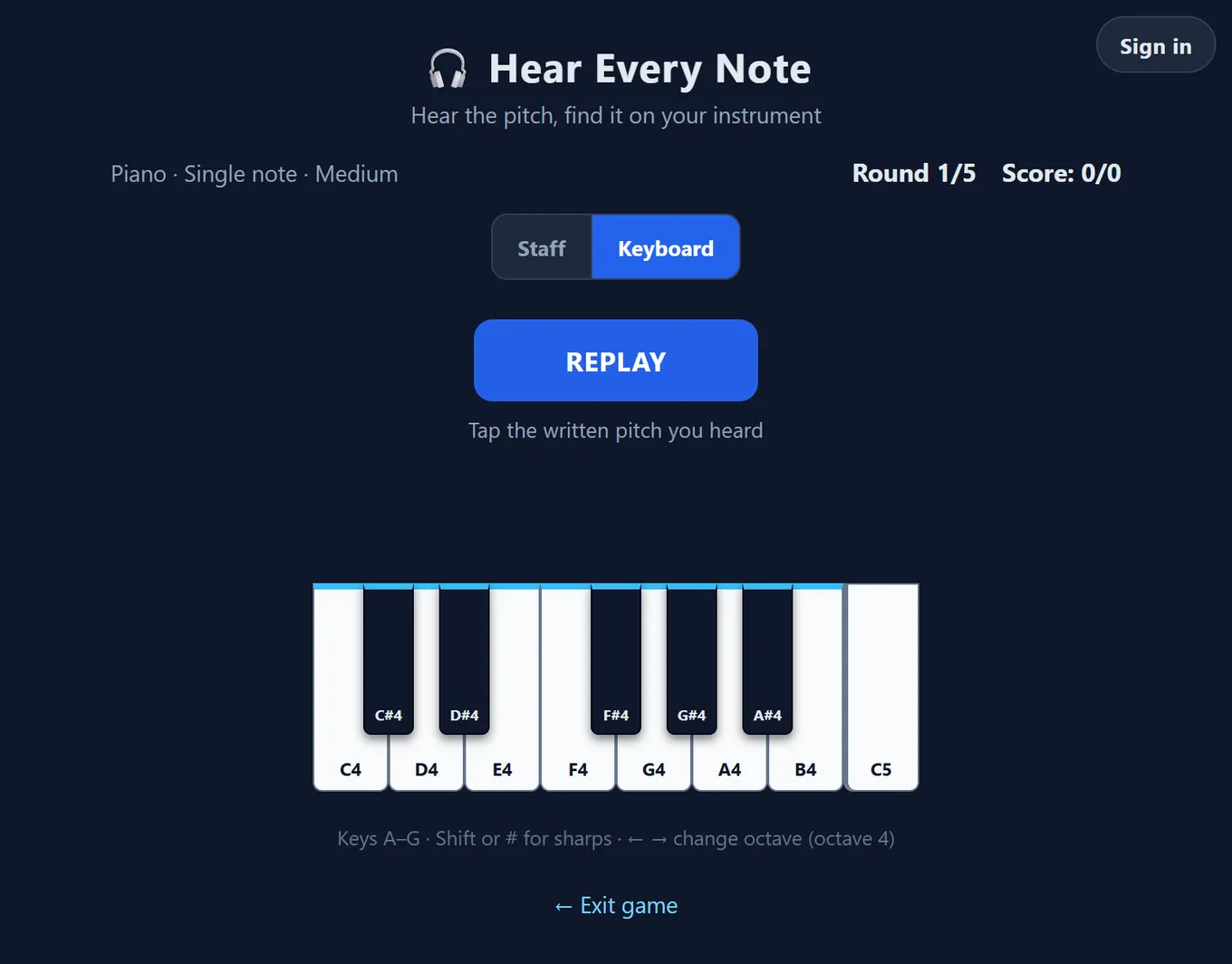
- Single notes first. Build pitch memory with note recognition: hear a note, hold onto it, find it on a staff or keyboard.
- Then intervals. Learn the distances two notes at a time with the interval trainer; anchor songs help a lot at the start.
- Then chords. Learn to hear every voice inside triads and seventh chords with the chord trainer.
- Keep sessions short and daily. Ten minutes a day beats a weekend marathon every time, and the daily challenge exists to make that habit automatic. The full progression is in our beginner's guide to ear training.
Frequently asked questions
Can adults learn perfect pitch?
Almost never, honestly. Genuine perfect pitch develops in early childhood, and research on adult acquisition shows only partial, hard-won gains that fade without constant upkeep. What adults can build is excellent pitch memory and near-instant relative pitch, and that covers everything musicians actually need.
Is relative pitch good enough for professionals?
Yes. It's what the overwhelming majority of professionals run on, including many famous composers and session players. Given one reference note, strong relative pitch identifies everything else by interval, and that's plenty for transcribing, improvising, arranging, and playing by ear.
How do I test whether I have perfect pitch?
Have someone play random single notes on a piano while you name them: no reference note, no instrument in your hands, no recent tuning note in your ear. If you consistently name notes cold, black keys included, across octaves, that's absolute pitch. If you name them after hearing one known reference, that's relative pitch.
How long does it take to develop good relative pitch?
With ten minutes of daily practice, most people can recognize the common intervals reliably within one to three months, and handle chords and inversions within six. Your ear keeps sharpening for years after that, but the useful threshold arrives fast.
Related reading: what is an interval? · a 10-minute daily routine · the beginner's guide