Ear Training for Pianists
The piano is the one instrument that plays a bass line, a chord and a melody at the same time, which makes it the best instrument for ear training and, strangely, the one whose players most often skip it. Pianists read well. A lot of them cannot play a simple tune by ear. This page is about closing that gap.
Start training on pianoA real sampled grand piano on every round. Free, and no account is needed.
Concert pitch, grand staff, all 88 keys
Piano is a concert-pitch instrument: the note you hear is the note you write, with no transposition to think about. The app plays a sampled grand piano and you answer either on a grand staff, treble and bass together, or on a row of on-screen piano keys, whichever you think in. On Hard the range is the whole keyboard, A0 to C8. Easy is the C major scale from middle C up to C5, Medium is that same octave chromatic, and Custom lets you set any span you like: the bass clef alone, say, or the two octaves where your left hand does most of its work.
The choice of input matters more than it looks. Most pianists' pitch memory is tied to the geography of the keyboard, so answering on the keys uses a map you already have. Answering on the staff builds the link in the other direction, from sound to page, which is the skill you need to write down a tune you heard on the radio. Alternate between them.
Why good readers need this most
Reading is the pianist's strength and the pianist's trap. If the page always tells your fingers what to do, your ear never has to. That works right up until a singer asks you to take the song down a step, a guitarist calls a tune you have never seen written out, or your memory slips in the middle of a recital and you have no idea what chord comes next because you only ever knew it as a finger pattern. Memorizing by ear, as harmony rather than as choreography, is what keeps a piece standing when nerves knock out the motor memory. And accompanying, arranging and composing all start from hearing a chord before you play it.
Start with single notes anyway, even if it feels beneath you. The note recognition trainer builds the raw pitch memory that every later skill draws on, and it shows you quickly whether your ear is as strong in the bottom two octaves as it is around middle C. For most pianists it is not.
Chords are the piano's home ground
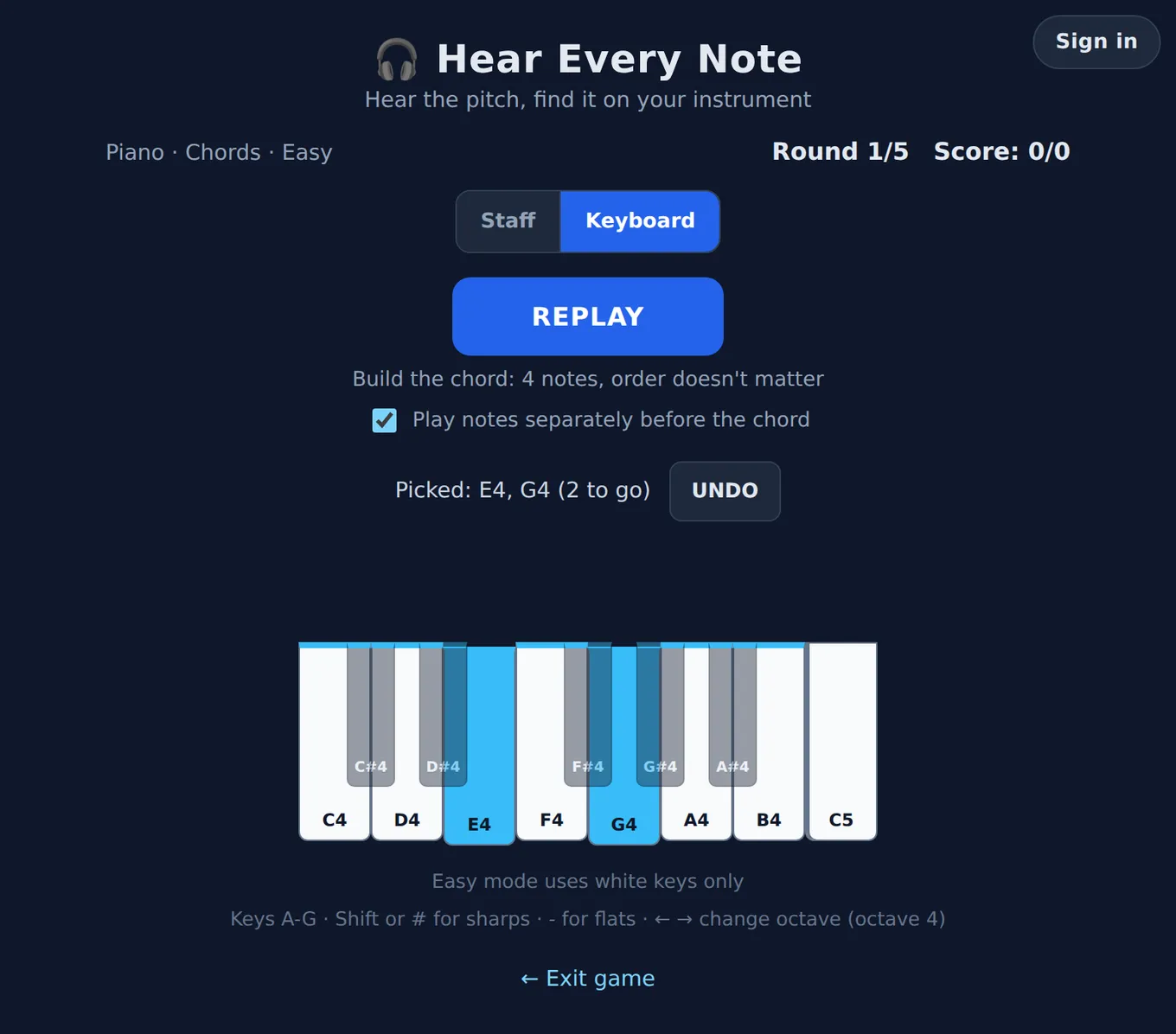
Chord mode is offered only to instruments that can play more than one note at a time, and piano is the model for it. The app plays a full chord in the piano sound and you pick out every note, from the bass up, on the keys or the grand staff. Begin with the arpeggio toggle on, so the notes arrive one at a time, and switch it off as soon as you are beating chance. Major and minor triads first, then diminished and augmented, then seventh chords and inversions. Inversions deserve particular attention from a pianist: the same chord with the 3rd in the bass is a different sound, and the bass note is always the first thing to catch. The chord trainer page has the full list of qualities, and how to recognize chords by ear gives you the listening order.
Intervals are the pieces chords are made of, and a pianist's priorities are specific. 3rds and 6ths, because they are how you harmonize a melody in the right hand. Perfect 5ths and octaves, because they are the left hand's bread and butter. The tritone, because it is the tension inside every dominant 7th chord and the engine of every resolution. And major 7th against minor 7th, because that one interval separates a maj7 from a dominant. Work them in the interval trainer on the grand staff so that low intervals in the bass clef get as much time as high ones.
Jazz progressions: the mode built for piano
Piano is the only instrument here with the jazz progressions mode, because it is the instrument that plays the changes. A piano-and-bass duo plays a two or four bar progression in a random key at a medium swing, the key is shown on screen, and you name the chord in each bar. On Easy you answer with Roman numerals from the seven diatonic seventh chords, so the question is function: is that the ii7 or the IV7? On Medium and Hard you give the exact chord symbol from a root picker and a quality picker, and the templates add augmented chords and 9ths, then sus chords, 11ths, 13ths, tritone substitutions and backdoor progressions. The piano voicings are rootless, the way a working pianist plays them, and the bass puts the root on the downbeat without giving away the quality. If you have ever sat in on a tune you did not know and tried to catch the changes as they went by, this is that, with a replay button.
A 10-minute routine for pianists
- 2 minutes: single notes. Note recognition on the grand staff, not the keys. Sing each note before you place it.
- 3 minutes: intervals. Interval mode, with the Custom range dropped into the bass clef every other day.
- 3 minutes: chords. Chord mode, arpeggio toggle off, inversions on once root position is above 80 percent.
- 2 minutes: changes. One game of jazz progressions, or the daily challenge on the days you want to keep the streak alive.
Once a week, sit at the real piano with a song you like and work out the chords by ear before you look at any chart. Bass note first, then quality, then the melody on top. The routine above makes each of those steps faster; the weekly song is what proves it. If you are new to ear training altogether, the order and the pacing are laid out in how to train your ear.
Frequently asked questions
Do pianists need ear training if they read well?
Especially then. Strong readers let the page do their hearing, and it shows the first time they must play by ear, transpose for a singer, or recover from a memory slip. Ear training gives you a second route to every note.
Should I answer on the keys or on the grand staff?
Both. Keys use the keyboard map your pitch memory already has; the staff builds the link from sound to notation. Alternate week to week.
What is the difference between chord mode and arpeggio mode?
Chord mode plays every note at once and you find them all from the bass up. The arpeggio toggle plays the same chord one note at a time, which is the easier place to start.
What is the jazz progressions mode?
A piano-only mode where a piano-and-bass duo plays a short progression in a shown key and you name each bar's chord: Roman numerals on Easy, exact chord symbols with extensions and substitutions on Medium and Hard.
Related instruments: piano stands on its own here, but the other chord-playing instruments face the same listening problems from a different angle. See ear training for guitarists for chords on a fretboard, bass guitar for the bottom of the progression, and ear training for singers if you accompany vocalists.