Ear Training for Saxophone
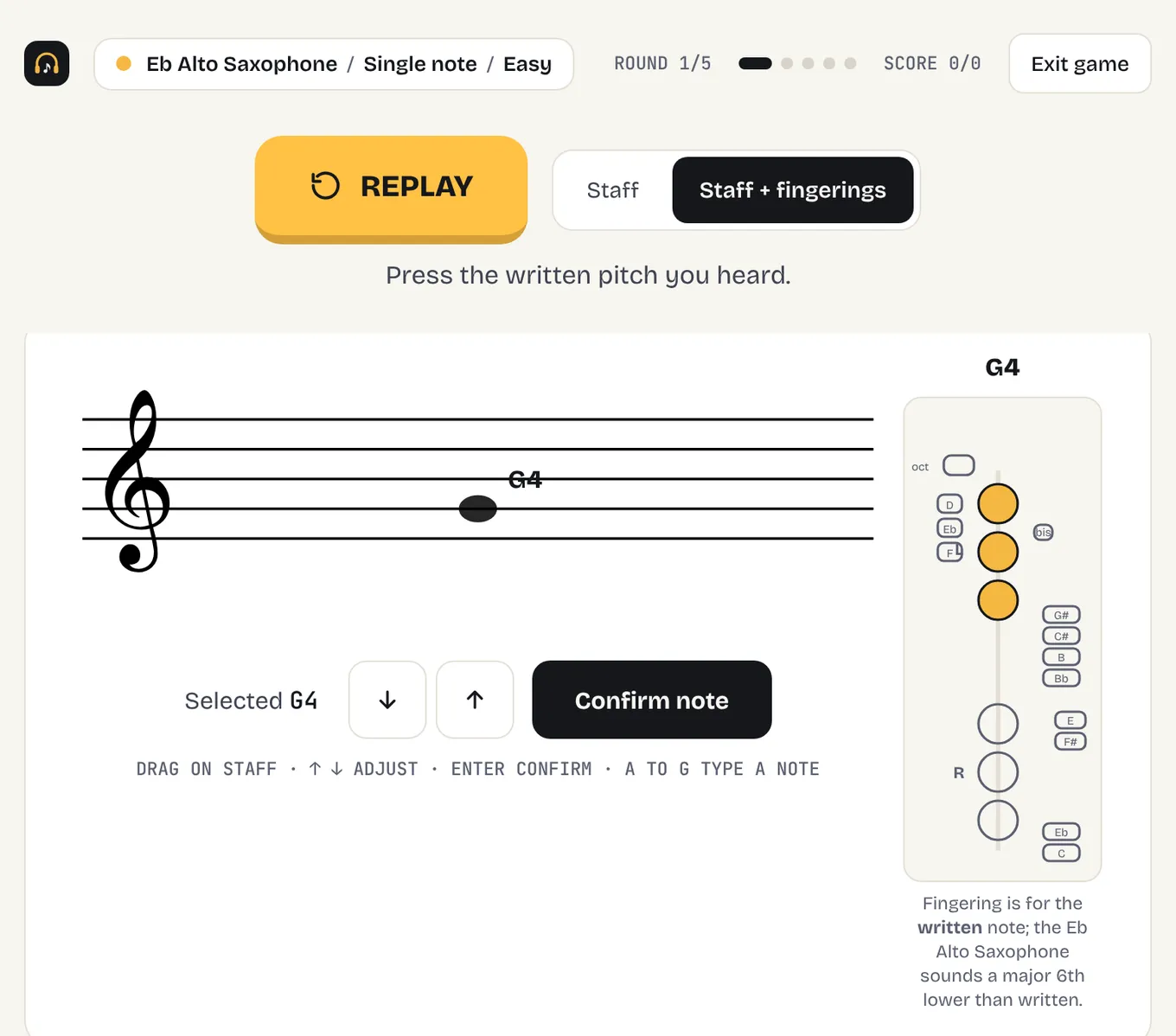
Ear training for saxophone means hearing the concert pitch that leaves the bell and answering with the written note on your part. This trainer does exactly that, with a recorded soundfont sound for soprano, alto, tenor and baritone, a treble staff, and the fingering chart all four horns share. Pick your sax and the first note plays.
Each button opens the game on that saxophone: note recognition on Easy, answered on the treble clef staff or the fingering chart. Press PLAY and the first note sounds. Free, no account.
One fingering system, four transpositions
Every saxophone reads the same page. Written C is the same fingering on soprano, alto, tenor and baritone, which is why a player can pick up any of the four and play the part in front of them. What changes is the sound that comes out. Each horn is a transposing instrument in a different key, so the same written note lands in a different place in the room. The full story of why instruments transpose, with every horn in one table, is in written pitch vs concert pitch.
| Saxophone | Key | Sounds | Written range in the app | Sounds as |
|---|---|---|---|---|
| Soprano | Bb | a major 2nd lower | Bb3 to F#6 | Ab3 to E6 |
| Alto | Eb | a major 6th lower | Bb3 to F#6 | Db3 to A5 |
| Tenor | Bb | a major 9th lower (an octave and a 2nd) | Bb3 to G6 | Ab2 to F5 |
| Baritone | Eb | an octave and a major 6th lower | Bb3 to F#6 | Db2 to A4 |
The trainer handles this for you. Choose a saxophone and it plays the concert pitch through that horn's sampled sound, then asks for the written note, which is the direction you work in on a gig: sound in the room, note on your part. Easy difficulty uses the written C4 to C5 major scale on every sax, so it sounds Bb3 to Bb4 on soprano, Eb3 to Eb4 on alto, Bb2 to Bb3 on tenor and Eb2 to Eb3 on baritone. Medium adds the chromatic notes in that octave, and Hard opens the full written range in the table.
Which sax to practice on
Train on the horn you will be holding when it matters. If you are an alto player in a concert band, practice on alto. If the big band book puts you on tenor on Thursdays, play your Thursday games on tenor. The fingerings carry over between the horns; the hearing does not. A written G sounds a perfect 4th apart on alto and tenor, and tenor and baritone live an octave below soprano and alto, so an ear trained on one register is slow to trust the other.
Doublers get the most from this page. Spend most of your ten minutes on your main horn, then play one scored game on the horn you double, and notice how long it takes for the lower or higher register to stop sounding wrong. That lag is exactly what shows up on the bandstand when the chart changes horns, and in my experience it shrinks once you play regular games on each.
The fingering chart, and when to use the staff
The four saxophones share one written-pitch fingering chart in the app, and you can answer on it instead of the staff. It is the right place to start if you learned the horn before you learned to read: you hear the note, you press the fingering you would use, and the app marks it. The chart covers the standard written range, Bb3 to F#6. Only tenor goes higher in the app, to written G6, and that note shows as altissimo with no standard fingering, because every player's altissimo fingerings differ. Tenor and baritone players who double a bass line off a recording still answer on the same chart in written pitch.
Move to the staff as soon as reading is comfortable. The staff asks for the written pitch in the same notation as your part, so every round is a repetition of the concert-chart conversion a jam session hands you. I play saxophone myself, and the staff is where the transposition finally stopped being arithmetic.
What to train on any saxophone
Start with note recognition on your horn, then intervals. Major and minor 2nds come first because scales and chromatic runs are made of them, then 3rds, the chord tone a sax most often holds in a section, then 4ths and 5ths, the references you tune to. Interval mode has you place both pitches; Interval names asks for the name. Chords come to the sax as Arpeggios mode, in your horn's own voice. Each saxophone's own guide has a 10-minute routine built around its register and repertoire: soprano, alto, tenor, and baritone.
Frequently asked questions
Why does the saxophone play a different note from the piano?
Because every saxophone is a transposing instrument. The note on your part is not the note the room hears: soprano and tenor are in Bb and sound a major 2nd or a major 9th lower than written; alto and baritone are in Eb and sound a major 6th or an octave plus a major 6th lower. Parts are written this way so that one set of fingerings reads the same on all four horns.
Do I need separate ear training for alto and tenor?
The fingerings and the written notes are identical, so the reading side carries over. The hearing side doesn't: the same written note sounds a perfect 4th apart on alto and tenor. Train on the horn you have the gig on, and play a game or two on the other one whenever you double, so your ear stops expecting the wrong register.
Can I answer on a saxophone fingering chart instead of reading the staff?
Yes. All four saxophones share one written-pitch fingering chart in the app, and you can switch between the chart and the treble staff at any time. Start on the chart if you know fingerings better than notation, and move to the staff as your reading catches up. The chart covers the standard written range up to F#6; only tenor goes higher in the app, to written G6, which shows as altissimo with no standard fingering.
Which saxophone sounds does the trainer have?
Soprano, alto, tenor and baritone, each played from recorded instrument samples in a General MIDI soundfont, served from the site itself. Pick one and every note you identify plays in that horn's own register at concert pitch, while you answer in written pitch. It's free, runs in the browser on phone or desktop, and needs no account.
Note recognition on Easy; press PLAY to hear the first note. Playing another horn? The tenor, soprano and baritone buttons are at the top of this page. Free, no account.